Sunday, September 2, 2012

Fuerza


The taco place is popular, located in downtown McAllen. “Expensive, though,” said a friend.

But no one bought lunch there last Thursday. About twenty of us gathered in front of the place at noon, having been asked by Fuerza, the Equal Voice Network’s workers’ center, to protest on behalf of some of the restaurant workers. Two of the cooks who  had been working  in the kitchen had recently complained to the Fuerza leaders that the owner was refusing to pay them, claiming that he “was short of cash.” 

Hector, the charismatic Fuerza leader, had taken the workers’ complaints and then had gone through the protocol—making sure of the facts, getting names and dates, seeing if the Department of Labor would take the complaint, and then, called the owner, asking for restitution.

Normally the owner gives in, although rarely admitting guilt. This time, though, the fellow kept putting the workers off. Days of delay turned into weeks and then months. Hector felt that it was time to pressure the guy, to show some force.

Thus, our lunch time protest.

We had signs that said “No to wage theft!” and “Justice for Workers!” and a small megaphone for chants.

The restaurant owner refused to come out to talk. He locked the door, and placed a “Closed” sign in the window. Every now and then a potential customer would come up, pull on the locked door, then look at the protesters, and move on, his inconvenience written across his brow.

Juanita, one of the workers, walked with us in front of her former workplace.  She was so angry that tears welled up in her eyes when she explained how she had helped the owner set the restaurant up. “The menu, the recipes, I created those. I feel humiliated.”

As the noon hour came to a close, we gathered into a circle, and, speaking past the closed front door, assured the owner that we would be back, again and again, until he did right by his workers.

Two days later, and on the other side of the Rio Grande Valley, stands at a ballpark were filled with fans looking forward to a last baseball game of the summer. Two of my friends joined the crowd. They struck up a conversation with another spectator, a woman who turned out to be married to the home team’s pitcher. 

As game time approached, my friends noticed that only the visiting team suited up. The pitcher’s wife, speaking on her cell phone, quietly said, “Our team is refusing to play. The owner won’t pay them their salaries. The checks that he wrote them bounced. So they won’t come out of the locker room.” Not a lot of money in any case, the wife explained—only about $600 a month. She, pregnant, and her husband, share an apartment with two other players.

After a while, the ballpark manager invited the kids to come down to the field to engage in a dance contest. And then, to a second dance contest. It was now forty-five minutes past starting time, and it was clear that there would be no game.
My friends got up, headed down to get their money back, and then set out for home.  They stopped by our house to share their excitement. “We saw a strike! Imagine that, we saw a strike on Labor Day weekend! What a great thing!”

The Labor Day weekend is bookended this year by the two major political parties’ campaigns. Both campaigns are making promises about having the answer to our nation’s economic woes, both campaigns claiming to understand “the big picture,” and that “big picture” seems to be all about powerful, untouchable greed

Locally, a couple of cooks and some minor league ball players are doing their best to get paid their very small wages. However small, they are their wages, and they are  wages that had been stolen.

While the greedy ones are indeed quite powerful, on this Labor Day weekend, I was pleased to be reminded that workers, in their own way, also have a good deal of power, of “fuerza.” What could happen if all that fuerza were harnessed and then unleashed? Now that would be a ball game worth watching.


Sunday, August 26, 2012

The Caravan for Peace


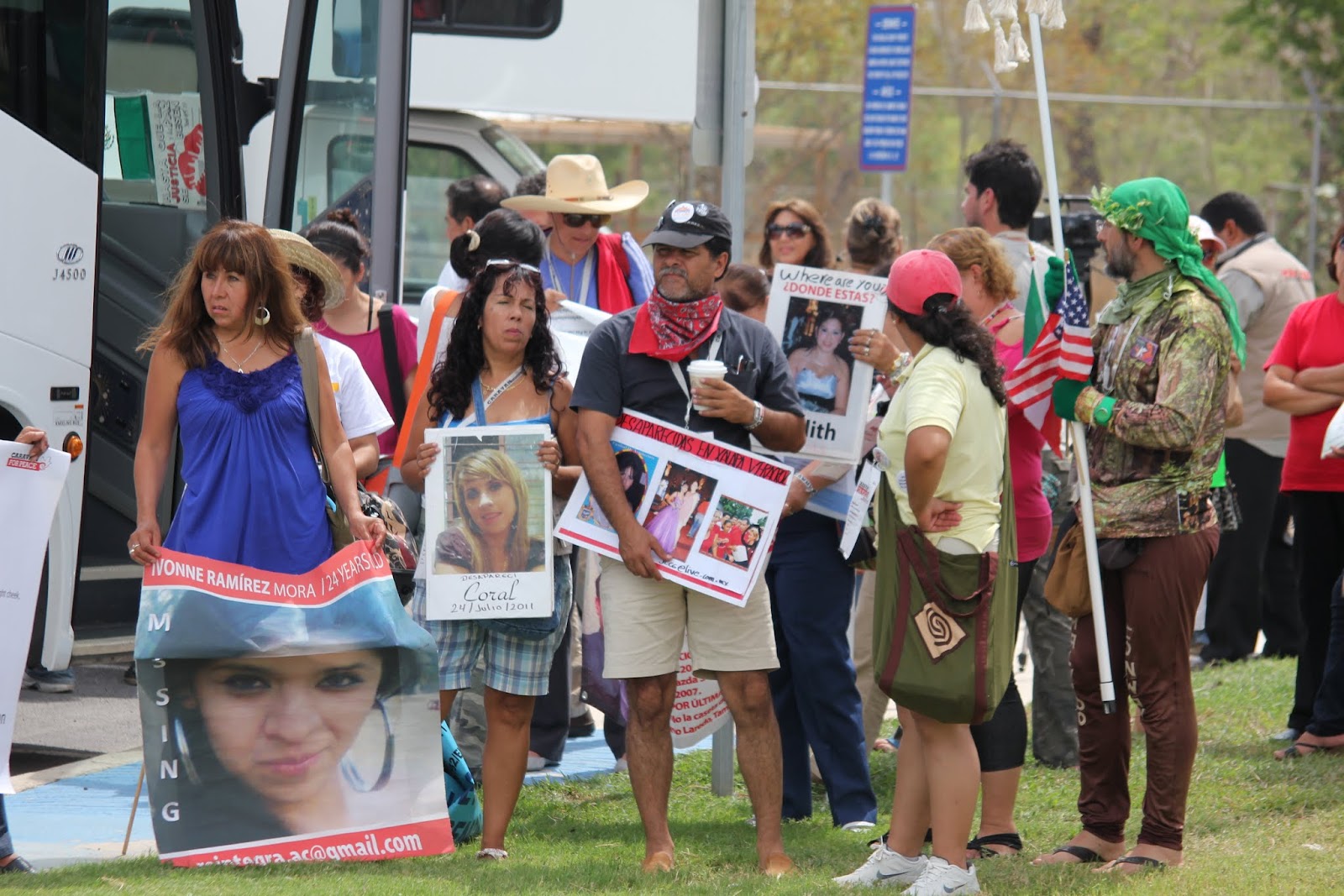
Two buses and a string of automobiles, pickup trucks and a police car rolled into south Texas this past Thursday. The Caravan for Peace, a group of the victims of the drug war in Mexico, were traveling from San Diego to Washington, DC. They did us the favor of pausing for a visit, spending an afternoon sharing stories under the blessed shade of mesquite trees, and then an evening in Brownsville in prayer and vigil.

As the visitors piled off the bus, they picked up and then carried forward several  large photos of their beloved, as well as some signs and an elegantly woven peace dove. 

One fellow, dressed oddly with green mittens and a green head scarf, seemed to be in charge of the ambience. He jumped up and down off of the stage, adjusting a photo here, hanging a sign there. I was told by one of the caravaners that he was “el hombre árbol” (the tree man)--that when his brother had been murdered by drug traffickers, that he had had a vision of a tree split down the middle by a lightening strike. 

He felt as broken as that tree, and so, now, he dressed the part. 

There were a couple of hundred other people travelling with him, amongst them the Mexican poet Javier Sicilia, a man whose poetry and peace were taken from him by the men who gunned down Sicilia’s son, another innocent victim amongst the more than 120,000* people who have died since Mexican President Calderon declared his version of the war on drugs. 

Although lovely, and gentle and kind, it was hard to be with these visitors.  They  were people who had suffered the unimaginable loss of loved ones--sons, daughters, husbands, wives—a loss that occurred, often, in unspeakable ways. 

One woman spoke of her interminable search for her daughter, a young woman who had gone off to work one day and then simply never came home. In the end, the woman told us, she had to resort to bribery. After she paid off the police, some local authorities, and then a judge, she was finally shown the headless corpse of a woman.  The mother paused at this point of her story, and then noted that her search was not yet over, that she could not rest until she recovered her daughter’s head.

Another spoke of a friend who was a journalist who had reported on the drug violence, and who had been tortured, and then burned alive.

I find it hard to know what to do with myself in these conversations, where to put my hands, how to look at the person telling me of the horror that lives on in their hearts and souls. Inevitably, I am thanked for listening.

It is listening that is being asked of us, those who meet these pilgrims. They and their stories, their photos and their grief were travelling across the United States as a reminder that America’s hands are not clean in this slaughter—the drugs come north, driven by our “recreational” consumption; we send the weapons south, enjoying the easy profits that our American fascination with guns creates; and, twistedly, the profits rest in a banking system, ours, that is “too big to fail,” and therefore, in so many ways, untouchable. It is one thing to read about this and to hear news reports on the violence. It is quite another thing to meet someone who has been damaged by this violence. In that encounter, about all one can do is listen.

After spending the afternoon in Alamo, the Caravan for Peace took their message to Brownsville, where on Thursday, August 23rd, the group paused for prayer at the border. That particular Thursday was the second anniversary of the massacre of 72 immigrants from Central and South America by the Zetas drug gang in San Fernando, a small village just south of Brownsville. 

Those 72 were headed for this very wall, in an attempt to cross it, to come to America, in the simple, time-worn hope of creating a better future for their children. According to a witness who survived the massacre, the immigrants were killed when, to a person, they refused to join the drug gang. They were killed for refusing to become killers.

I continue to marvel at that sacrifice.

In the face of such evil, in the face of a situation that seems so entirely bereft of answers, this group of human beings has resorted to liturgy—to a public sharing of their lamentation, of their deepest sadnesses, and of their anger, as well. This is, in my mind, not so much a caravan, as a procession. They have their altar; one maintained by an acolyte dressed in green who wears, so to speak, his hope on his sleeves. They have, as well, their sacred scriptures, in those heartbreaking stories of these victims. 

And they have faith, one no less noble than any other religious faith, even if more absurd, for they actually believe that their stories will be heard and that, in some way, things will change. 

I don’t yet share their faith, for I haven’t heard a single proposal to end the violence that makes much sense. In any case, my mind is filled with the image of a woman looking for her daughter’s head.

I sit in silence and wonder how to pray about that.

The progress of the Caravan for Peace can be followed here:
http://www.globalexchange.org/mexico/caravan/

*(The US and Mexico press typically cite between 50,000 and 60,000 deaths in Calderon's war on drugs, but an editorial in last week's Le Monde plus the well-considered work of other researchers put the toll at OVER 120,000--Mexique, la spirale de la barbarie; LE MONDE  23.08.2012. The Mexican government's "official" count only includes those deaths certified by the equivalent of a coroner. Missing (in so many ways) from these figures are the disappeared, the unclaimed bodies, or those in mass graves)

Tuesday, July 31, 2012

Reparador de Sueños


Elsa Gonzalez at public hearing on housing
Last week the Marguerite Casey Foundation invited 400 people from across the country to travel to Los Angeles. The Foundation had created a space for sharing and collaborating on a national platform for all of those families who have been typically ignored by the political powers that be. For three days, Americans who think seriously and responsibly about our possibilities as a nation shared struggles, ideas, and resources in a conversation that crossed gender, race, and culture.

Elsa Gonzalez was one of those who perhaps journeyed the furthest to reach the meeting. Elsa lives in Green Valley Farms, a community of about 1,000 people deep in the heart of south Texas. Although she had spent her entire adult life struggling—successfully—to raise her family, and although she had often offered a hand out to neighbors in need, she was new to the experience of community organizing.  

The South Texas Adult Training and Resource Center (The START Center) had invited Elsa to join a neighborhood team that would study the challenges that faced Elsa’s community—most notably, the flooding that occurs each and every time that there is a significant rainfall.

After years of fighting the despair that crept into her heart each time she had to return to her flooded home, the idea that someone else—and someone not from the neighborhood—cared about her and her neighbors was like a tonic. The notion that she, Elsa Gonzalez, was being asked to lead this neighborhood team, was exhilarating.

And now she was in Los Angeles, surrounded by hundreds of people who dared to play the role of advocate, angel or saint from hundreds of other communities that were routinely ignored by the nation’s leaders.

After the second day, Elsa was exhausted, overwhelmed by the energy, the enthusiasm, the hope. She skipped a session to simply rest in her room.

As she sat there, considering it all, a hotel maid knocked on her door, wanting to clean the room. The two women began to talk, both Mexican, both poor, both mothers looking for away to change things. Elsa’s home was flooded by rainwater; the maid’s home was flooded by rats and roaches. Elsa staved off despair; the maid was on the verge of giving in. “What can I do?” she pleaded, and Elsa, the new community advocate, told her, “I will help you,” and took down the woman’s name and phone number, left her room and returned to the 400 saints and angels who were downstairs, looking for help for her new friend.

“Ya le hice un compromiso,” she said, “This is now what I do.”

There are those who would dismiss her action as piety, or, at best, charity. Elsa might well agree with that. And she might well note that the very first step in organizing for change is forging a bond. The most effective of those bonds reach across gender and race and—in this case—geography.